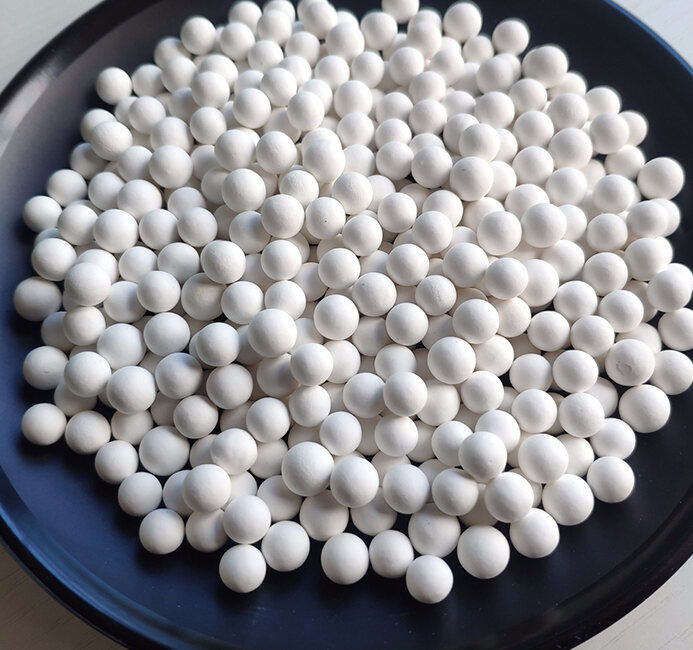
Activated alumina is a porous adsorbent widely used in gas drying, water treatment, fluoride removal, and arsenic removal. Its adsorption performance is influenced not only by the adsorbent itself, but also by operating conditions and feed-water quality. Proper product selection and process optimization can improve treatment efficiency and extend service life.
Specific surface area and pore structure are fundamental to adsorption capacity. A larger surface area provides more available adsorption sites, while suitable pore volume and pore size distribution help contaminants enter the internal pore network and improve mass transfer. Blocked pores or an unsuitable pore structure can significantly reduce adsorption efficiency.
Smaller particles generally shorten diffusion paths and improve adsorption kinetics. However, excessively small particles may have lower mechanical strength, increased attrition, and higher pressure drop during operation. A practical balance is therefore needed between adsorption efficiency, mechanical durability, and hydraulic resistance.
Raw material purity, calcination temperature, calcination time, and shaping methods influence crystal phase, surface hydroxyl groups, pore structure, and mechanical strength. Consistent manufacturing helps produce activated alumina with stable adsorption performance, uniform pore characteristics, and improved regeneration resistance.
Many adsorption processes are exothermic. As a result, higher operating temperatures generally reduce equilibrium adsorption capacity. Performance under elevated temperatures should be evaluated according to the specific medium and process conditions.
In gas drying applications, a higher water vapor partial pressure typically increases the driving force for moisture adsorption. However, it can also cause the adsorption bed to reach saturation more quickly. Bed sizing and switching cycles should be designed according to inlet humidity, target dew point, and flow rate.
Flow rate determines the residence time of the fluid in the adsorption bed. Excessive flow rates may lead to insufficient contact and early breakthrough, while very low flow rates can reduce overall treatment capacity. Proper flow control and bed design help balance adsorption efficiency and process throughput.
Regeneration has a major impact on long-term adsorbent performance. Insufficient regeneration may leave residual contaminants on active sites, while overly severe regeneration conditions may cause sintering, pore damage, and capacity loss. Adsorption capacity generally declines gradually after repeated operating and regeneration cycles, making regular performance monitoring important.
Activated alumina generally performs better for fluoride removal under mildly acidic conditions. When the water pH is above 5, reducing pH within an appropriate operating range can often improve fluoride adsorption capacity. pH adjustment should be considered together with effluent requirements, chemical consumption, and downstream neutralization needs.
A higher initial fluoride concentration can increase the mass-transfer driving force and may raise the apparent adsorption capacity per unit mass of adsorbent. At the same time, it can shorten bed breakthrough time and require more frequent regeneration or media replacement.
Bicarbonate, sulfate, chloride, and other dissolved ions may compete for adsorption sites or alter the surface charge of activated alumina. High alkalinity is often unfavorable for fluoride removal. Water pretreatment or feed-water adjustment may be beneficial when alkalinity or interfering-ion concentrations are high.
Activated alumina can also adsorb arsenic from water. Over time, arsenic may accumulate on the adsorbent surface and occupy active sites, reducing fluoride removal capacity. In addition, spent media and regeneration wastewater containing arsenic should be handled in accordance with applicable environmental and safety requirements.
The adsorption performance of activated alumina depends on the combined effects of material properties, operating conditions, and water quality. For reliable results, adsorbent selection and system design should consider target contaminants, influent composition, treatment capacity, flow conditions, and regeneration requirements.
CarbonFresh produces high-quality activated carbon designed for air purification, gas treatment, water filtration, wastewater treatment, and adsorption applications. Our products can be supplied according to customer requirements for pellet diameter, iodine value, CTC activity, ash content, moisture content, hardness, and packaging.
We offer free samples for quality evaluation and comparison.
For product inquiries, technical support, or samples, please contact:
Email: info@carbonfreshcn.com